EVO ICL® in Chicagoland
EVO ICL® (Implantable Collamer® Lens) is an advanced vision correction option available at Kovach Eye Institute across Chicagoland, including Naperville, Elmhurst, Lincolnwood, and South Barrington. If you’ve been told you’re not a candidate for LASIK or SMILE, or if you’re seeking a reversible alternative to traditional refractive surgery, EVO ICL may be the solution you’ve been looking for. Our experienced surgical team specializes in this innovative procedure, offering patients the opportunity to achieve enhanced vision without corneal reshaping.


At Kovach Eye we believe in vision without limits.
Are you a candidate for vision correction surgery? Take our Vision Quiz to see if it’s a good fit!
What Is EVO ICL?
EVO ICL is a thin, biocompatible lens made of Collamer material that is surgically placed inside your eye, positioned between your natural lens and the iris. Unlike LASIK, which permanently reshapes the cornea, the EVO ICL does not remove any corneal tissue and is reversible, meaning it can be removed or replaced if needed in the future.
The procedure is FDA-approved and designed to correct myopia (nearsightedness) and astigmatism. The entire surgical process takes approximately 15 minutes per eye and is performed as an outpatient procedure.
How EVO ICL Works
During your EVO ICL procedure, your surgeon creates a small incision in the cornea and gently inserts the folded lens into the eye. Once positioned, the lens unfolds and settles into place behind the iris. The lens works by bending light rays as they enter the eye, correcting refractive errors and allowing light to focus properly on the retina.
Because the lens is placed inside the eye rather than on the corneal
 Trusted Source
Geometric, Physical, and Visual Optics
Keating MP
Go to Source
surface,
it provides consistent optical correction without the fluctuations sometimes associated with other vision correction
Trusted Source
Optics of human eyes
Milder B
Go to Source
methods.
The procedure preserves corneal tissue, which is particularly beneficial for patients with thin corneas or high prescriptions.
Trusted Source
Geometric, Physical, and Visual Optics
Keating MP
Go to Source
surface,
it provides consistent optical correction without the fluctuations sometimes associated with other vision correction
Trusted Source
Optics of human eyes
Milder B
Go to Source
methods.
The procedure preserves corneal tissue, which is particularly beneficial for patients with thin corneas or high prescriptions.

Benefits of EVO ICL
Reversibility: Unlike LASIK or PRK, EVO ICL can be removed or exchanged if your vision needs change over time.
Biocompatibility: The Collamer material is designed to be well-tolerated by the eye, with a low risk of rejection or inflammation.
Minimal Corneal Impact: Because the procedure does not reshape the cornea, it’s an excellent option for patients with thin corneas or those who want to preserve corneal tissue.
High Prescription Correction: EVO ICL effectively corrects moderate to high myopia and astigmatism, often providing results for patients who don’t qualify for LASIK.
Fast Visual Recovery: Many patients experience improved vision within days, with continued improvement over the following weeks.
Enhanced Night Vision: The EVO ICL’s design minimizes halos and
Trusted Source
Effect of the EVO+ Visian Phakic Implantable Collamer Lens on Visual Performance and Quality of Vision and Life, Am J Ophthalmol 2021;226:117-125
Martínez-Plaza E, López-Miguel A, López-de la Rosa A, et al
Go to Source
glare,
providing excellent vision in low-light
Trusted Source
A prospective comparison of phakic collamer lenses and wavefront-optimized laser-assisted in situ keratomileusis for correction of myopia
Parkhurst GD
Go to Source
conditions.
No Dry Eye Complications: Unlike LASIK, which can temporarily or permanently affect
Trusted Source
Matched population comparison of visual outcomes and patient satisfaction between 3 modalities for the correction of low to moderate myopic astigmatism
Ganesh S, Brar S, Pawar A
Go to Source
tear production,
EVO ICL does not compromise the ocular surface, making it ideal for patients with
Trusted Source
Analysis on the changes of objective indicators of dry eye after implantable collamer lens (ICL) implantation surgery
Zhang H, Deng Y, Ma K, Yin H, Tang J
Go to Source
dry eye
concerns.
Long-Term Stability: The lens remains stable within the eye and does not require ongoing maintenance or replacement under normal circumstances.
EVO ICL vs. LASIK: Key Differences
While both procedures correct refractive errors, they work in fundamentally different ways. LASIK uses an excimer laser to reshape the cornea, whereas EVO ICL places a lens inside the eye. This distinction makes EVO ICL ideal for patients with:
- High myopia or astigmatism
- Thin corneas
- Dry eye concerns
- A desire for reversibility
LASIK may be appropriate for patients with lower prescriptions and thicker corneas. During your consultation, our surgeons will evaluate your individual eye anatomy and vision goals to recommend the best option for you.
Am I a Candidate for EVO ICL?
EVO ICL is suitable for patients aged 21 to 45 with stable vision prescriptions. Ideal candidates typically have:
- Myopia ranging from -3.00 to -20.00 diopters
- Astigmatism up to 4.00 diopters
- Healthy corneas and retinas
- No active eye disease or infection
- Realistic expectations about surgical outcomes
During your comprehensive consultation, our surgeons will perform detailed eye measurements and assessments to determine your candidacy. Some patients may not be suitable candidates due to factors such as keratoconus, severe dry eye, or certain retinal conditions. A thorough evaluation ensures your safety and optimal results.

The EVO ICL Procedure: What to Expect
Before Surgery
You’ll attend a pre-operative appointment where we’ll perform advanced imaging and measurements of your eye. You’ll receive detailed instructions on how to prepare, including guidelines about contact lens wear, medications, and what to bring on surgery day.
Day of Surgery
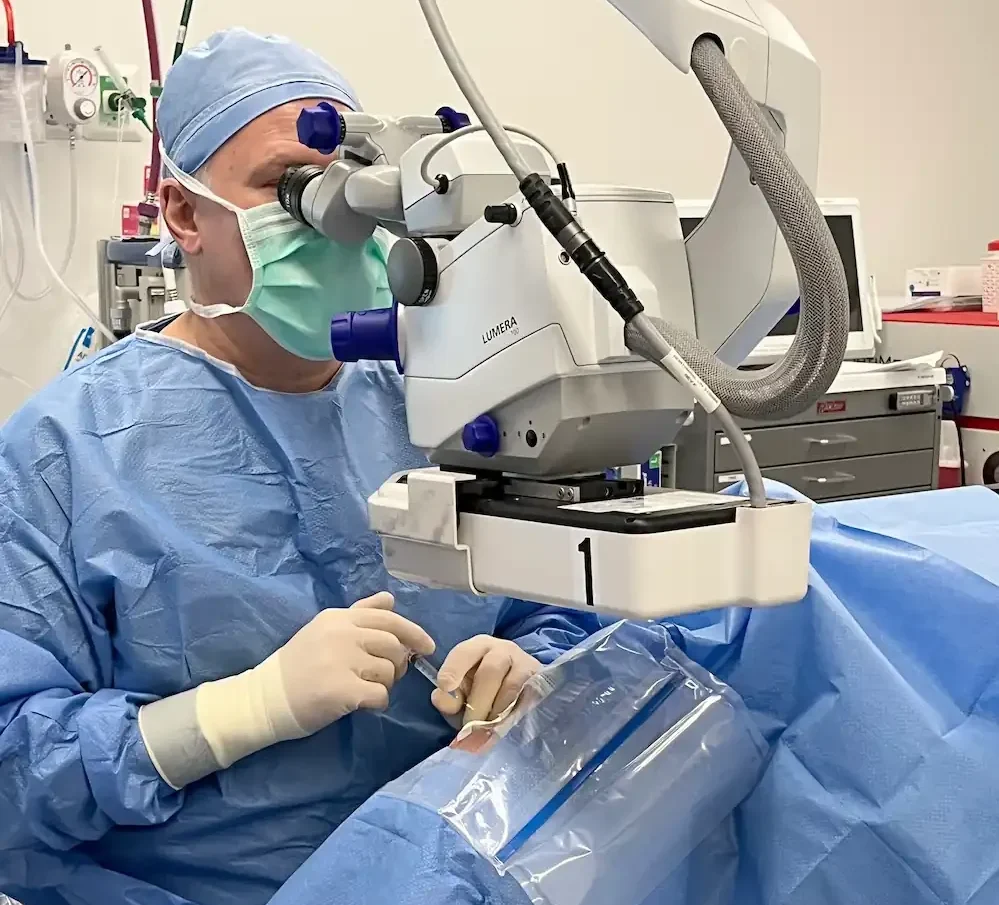
Arrive early for final checks and to receive numbing eye drops. You’ll be positioned comfortably under the surgical microscope. Your surgeon will create a small incision, insert the folded lens, and position it carefully. The entire procedure takes about 15 minutes per eye.
After Surgery
You’ll rest briefly in our recovery area before being discharged. You must arrange for someone to drive you home. Your vision may be blurry initially, but this typically improves within 24 to 48 hours. You’ll use prescribed eye drops and follow post-operative care instructions carefully.

Recovery and Results
Most patients notice improved vision within the first few days following EVO ICL surgery. However, vision continues to stabilize over the following weeks as your eye adjusts to the lens. Full visual stability is typically achieved within one to three months.
During your recovery period, you’ll attend scheduled follow-up appointments at one day, one week, one month, and three months post-surgery. These visits allow our surgeons to monitor your healing and ensure optimal lens positioning and visual outcomes.
You should avoid strenuous activities, swimming, and contact sports for at least one week. Most patients return to normal daily activities, including work, within a few days. Your surgeon will provide specific guidelines based on your individual healing progress.
Why Choose Kovach Eye Institute
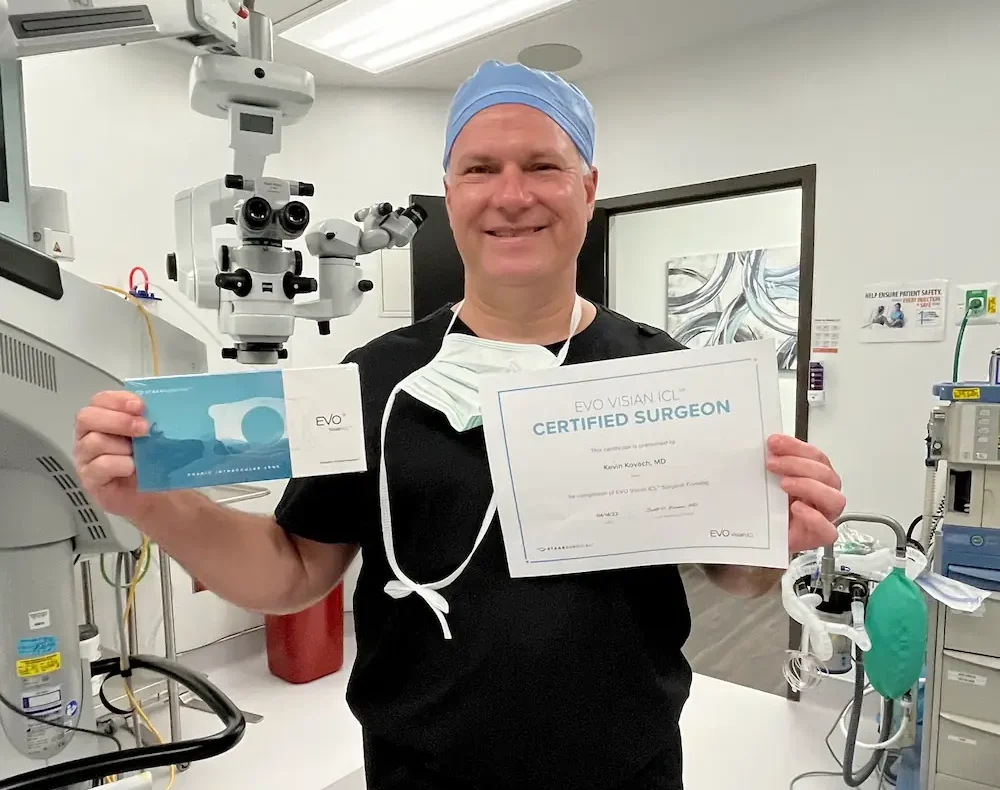
Kovach Eye Institute is a leader in advanced vision correction in Chicagoland. Our practice was the first in Illinois to perform EVO ICL surgery, demonstrating our commitment to offering cutting-edge procedures to our patients. Our surgeons bring decades of combined experience in refractive surgery and are dedicated to achieving the best possible outcomes for every patient.
Our Surgical Team
Our experienced ophthalmologists specialize in advanced vision correction procedures. Each surgeon maintains board certification through the American Board of Ophthalmology and participates in ongoing continuing education to stay current with the latest surgical techniques and technologies. Our team includes specialists trained in complex cases, including patients with high prescriptions, astigmatism, and previous eye surgery.
State-of-the-Art Technology
We utilize advanced diagnostic equipment and surgical technology to ensure precise measurements and optimal surgical outcomes. Our commitment to technology extends to our surgical suites, which are equipped with the latest microscopes and instrumentation.
Patient-Centered Care
From your initial consultation through post-operative follow-up, we prioritize clear communication and personalized attention. We take time to understand your vision goals and address any concerns you may have about the procedure.
Comprehensive Support
Our team provides detailed pre-operative education, meticulous surgical technique, and attentive post-operative care. We’re committed to your safety and satisfaction throughout your vision correction journey.


I am now six months post ICL surgery and I couldn't be happier with how Kovach took care of me. My cornea was too thin for Lasik and I've been wearing contacts for 35 years. With vision around -5.00 for each eye and some stigmatism, I was not going to be an easy patient. Seeing 20/20 still! Highly recommend considering ICL and Kovach for your eye surgery. - Brian O.
Dr. Kovach was great. He explained everything in the office and during the surgery. His staff at the office and surgical center were pleasant and thorough. A very pleasant and successful experience. Absolutely no complaints. - Mark N.

I had the ICL surgery to correct my vision. Before surgery, my vision was -11, the next morning I had 20/20 vision. I recommend Dr. Kovach to anyone who might be considering this surgery, he did a great job and really cares about his patients. - Natalia C.
Frequently Asked Questions About EVO ICL
The surgical procedure itself takes approximately 15 minutes per eye. However, you should plan to spend 1 to 2 hours at our facility for pre-operative preparation and post-operative monitoring.
No. Your eyes will be numbed with anesthetic drops before surgery, so you won’t feel pain during the procedure. You may feel mild pressure or slight sensations, but discomfort is minimal.
Many patients notice improved vision within 24 to 48 hours. Vision continues to improve and stabilize over the following weeks and months as your eye adjusts to the lens.
Yes. One of the key advantages of EVO ICL is its reversibility. The lens can be removed or exchanged if needed, though this is rarely necessary.
EVO ICL has a high success
Trusted Source
The Implantable Collamer Lens with a central port: review of the literature
Packer M
Go to Source
rate,
with the majority of patients achieving their target vision correction. During your consultation, we’ll discuss realistic expectations based on your individual prescription and eye anatomy.
You should avoid strenuous activities, swimming, and contact sports for at least one week. Most patients return to normal activities within a few days. Your surgeon will provide specific guidelines during your post-operative visits.
The lens is designed to remain stable within the eye indefinitely. It does not require replacement or ongoing maintenance under normal circumstances.
Most patients achieve excellent vision without glasses or contact lenses. However, some patients may need reading glasses as they age, particularly after age 40, due to presbyopia (age-related loss of focusing ability). This is a natural part of aging and is not specific to EVO ICL.
As with any surgical procedure, EVO ICL carries some risks, including infection, inflammation, or lens malposition. However, serious complications are rare when the procedure is performed by an experienced surgeon. During your consultation, we’ll discuss all potential risks and how we minimize them.
Pricing varies based on your individual prescription and specific needs. During your consultation, we’ll provide a detailed cost estimate and discuss financing options to make the procedure accessible.
Contact Us
Ready to explore whether EVO ICL is right for you? Schedule your consultation with our experienced surgical team at Kovach Eye Institute. We serve patients throughout Chicago with locations in Naperville, Elmhurst, Lincolnwood, and South Barrington.
Contact us today to schedule your appointment. Our team is ready to answer your questions and help you take the next step toward visual freedom.
1 Keating MP. Geometric, Physical, and Visual Optics. 2nd ed. Butterworth-Heinemann;2001. Accessed February 24, 2026.
2 Milder B. Optics of human eyes. Ocular Surgery News. March 23, 2011. Available: www.healio.com/news/ophthalmology/20120331/optics-of-human-eyes. Accessed February 24, 2026.
3 Martínez-Plaza E, López-Miguel A, López-de la Rosa A, et al. Effect of the EVO+ Visian Phakic Implantable Collamer Lens on Visual Performance and Quality of Vision and Life, Am J Ophthalmol 2021;226:117-125. Accessed February 24, 2026.
4 Parkhurst GD. A prospective comparison of phakic collamer lenses and wavefront-optimized laser-assisted in situ keratomileusis for correction of myopia. Clin Ophthalmol. 2016;10:1209-1215. Accessed February 24, 2026.
5 Ganesh S, Brar S, Pawar A. Matched population comparison of visual outcomes and patient satisfaction between 3 modalities for the correction of low to moderate myopic astigmatism. Clin Ophthalmol. 2017;11:1253-1263. Accessed February 24, 2026.
6 Zhang H, Deng Y, Ma K, Yin H, Tang J. Analysis on the changes of objective indicators of dry eye after implantable collamer lens (ICL) implantation surgery. Graefes Arch Clin Exp Ophthalmol. 2024 Jul;262(7):2321-2328. Accessed February 24, 2026.
6 Packer M. The Implantable Collamer Lens with a central port: review of the literature. Clin Ophthalmol. 2018;12:2427-2438. Accessed February 24, 2026.
The doctors at Kovach Eye Institute have either authored or reviewed and approved this content.
Page Updated: